


“Groundbreaking tests of quantum mechanics conducted between 1980 and 1982 ... provided definitive answers to the famous Einstein-Podolsky-Rosen (EPR) paradox and cemented quantum non-locality.” — Google A.I. summary
Something Between Arrogance and Lack of Judgement
The above A.I. statement is a fair summary of what physicists believe, what is currently stated in textbooks, and what I’ve now shown to be false. False assertions are accepted as truths because of poor research and exaggerated certitude. Exaggerated certitude comes from a reluctance to admit ignorance. This arrogance has always threatened science, it has percolated into politics and led to today’s Trumpian stupidness.
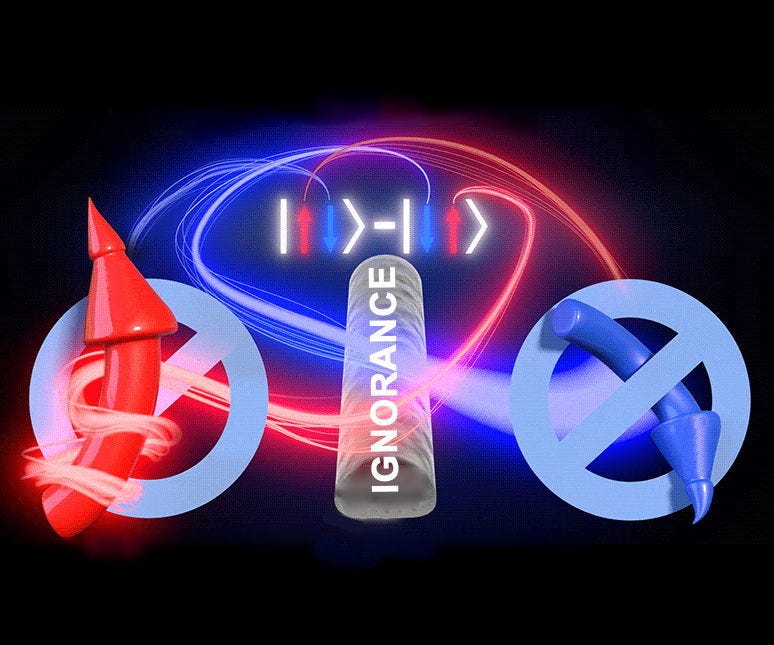
The EPR paradox, to which the above quote refers, is well described on Wikipedia (2026). The paradox arises from an explanation of why two elementary particles thought to have no fixed property to start with, and which have been separated any distance apart, suddenly and without any mechanism, display the same behavior when a particular property is measured. It’s a paradox because the mathematics makes the correct prediction but the physics makes no sense. The mechanism that’s proposed is called “action at a distance.”
The groundbreaking tests referred to above were conducted by Alain Aspect, for which he won the Nobel Prize in 2022, and which he describes in his acceptance speech:
His experiments are masterful, naturally, but he didn’t understand what he was looking at any more than anyone else did.
At 1 minute 10 seconds into the introduction the speaker refers to Bell’s assertion “that hidden variables theories, assuming locality, cannot explain the quantum mechanical predictions.” This imprecise statement of what Bell did, underlies the inaccurate understanding of what Aspect showed, leading to the incorrect conclusion stated in the above quote, resulting in his being awarded the Nobel Prize.
You will understand that when someone gets a Nobel Prize it’s because everyone endorses what they’ve done. The Nobel is a very “after the fact” award. In this case it was 40 years after the fact. It took that long for people to accept the nonsensical theory, which was the best anyone could come up with, and whose predictions were definitively observed by Aspect.
An original version of the paradoxical situation was stated by Einstein, Podolsky, and Rosen in 1936. Nobody knew quite what to make of it. In the same year, Neils Bohr published a confusing refutation of the paradox which has never been understood. David Bohm came up with a more intuitive version of the paradox in 1951. In 1964 John Bell showed the paradox’s greater importance, and Alain Aspect found a definitive test of the paradoxical predictions in 1980. Science is supposed to get incrementally more correct over time, but in this interesting case it got incrementally less correct.
Medieval Necromancy
The Middle Ages are remembered as a time when religion guided politics and magic provided explanations. This was followed by what those later called “The Enlightenment.” Those living before this time would have called such ideas heresy. The authorities tried to retrench, but The Enlightenment was too profitable.
The Enlightenment was the start of science as we know it, which asserts that all things have material causes. Central to this idea is that if you see things that don’t have material causes, then the correct explanation is not divine will, it’s hidden in your ignorance. Admitting this takes quite a bit of humility which, unfortunately, people keep failing to provide.
The conclusion that action-at-a-distance is a real thing is a consequence of the EPR paradox, and it emerged as a result of a lack of alternative explanations, combined with a society of physicists who could not admit there might be another explanation. A few people objected, notably Einstein himself, as well as E. T. Jaynes who said this explanation amounted to “medieval necromancy.”
If you’d like to learn more about the medieval necromancy of current quantum mechanics, read Sandu Popescu’s 2010 article “Non-locality Beyond Quantum Mechanics,” which you can find free online. You won’t understand it because it does not make sense—it’s just a mathematical prediction—but it’s interesting to see how what’s not believable, when couched in math, can be made to look believable. In the end, your intuition is correct: it’s nonsense.
Overconfident Mathematics
Mathematicians formulate proofs; physicists create arguments. You might think that proofs are better, but that depends on their being correctly applied. In between the certitude of proofs and the applicability of argument lies the dodgy realm of guess work.
In the original EPR paper the authors argued that if our mathematical formalism says that two things are true, but our physical theory says that one of them is false, then our physical theory is missing something. They asserted this was the case, but they couldn’t say what was missing.
David Bohm presented a simple example that was claimed to put the conflict in clear relief, but it actually highlighted a different problem. Then, Bell derived an expression he claimed was general, which it is not. Bell’s expression demonstrated that quantum mechanics and all variations of it will make predictions of the medieval necromancy sort, and all “reasonable” theories will contradict this.
Aspect’s experiment simply confirmed the quantum mechanical prediction which, on the basis of Bell’s misunderstanding, was supposed to lead us to conclude that no reasonable theory could ever explain what we see.
Notice where the potential for error lies. It lies in the intersection of what we know, what we don’t know, what the mathematics says, and what we see. When this involves nearly 100 years of mathematics, generations of a sort of “telephone game” between people reinterpreting the issue, and subatomic particles whose very identity is questionable, then you can understand how this situation developed.
Despite the phalanx of “true believers” in the action-at-a-distance theory, and their professional disinterest in pursuing the question further—not to mention the lack of funding for such work—some people continued to explore this heap of confusions. This is one of those problems where greater distance and a wider perspective is an asset. Because I have not been pressured to “move on,” to teach the doctrine, or engage more fashionable topics, I am one of the people who continued to believe the paradox deserved a solution.
It’s Not a Paradox, It’s a Problem
I seem to have solved this paradox, and the solution is that it’s not an unsolvable contradiction. It’s a technical problem that has been misunderstood and whose solution has been overlooked. My solution is something I put together from things discovered by other people. In this case, the parts are new and not to be found in the old discussions. They are not hidden clues buried with the old mystery, they are recent observations. The EPR paradox is like an old jig saw puzzle that’s been left on the table and to which few people have paid attention.
Some people have continued to put together little islands of pieces. I noticed that some of these islands fit together and, when put in their proper places, completed the picture. Now we have a quantum explanation that is local and complete, does not involve action-at-a-distance, does not contradict Bell’s assertions, disproves Bohm’s assertions, and confirms Aspect’s observations.
The conclusion is that Einstein was sort of right, Bohr was not helpful, Bohm was wrong but clarifying, and Bell’s result was stimulating but misunderstood. Aspect’s observations should have been seen as a call for an explanation, not a demonstration of the unreasonable.
The Details of the Paradox
There’s little point it getting into the details. It suffices to say that some of the mathematics was interpreted incorrectly. The mathematics that ultimately provides the missing explanation was missing in the early years because the correct equations had not been written. This leads down a technical rabbit hole which few readers would be interested in or have the time to follow. Consult my papers if you’re interested (Stoller 2025, 2026); I’ll tell you the interesting parts. It takes us back to the quantum uncertainty principle.
The uncertainty principle says there are some things that just cannot be measured at the same time and place. There are some properties that we consider basic to reality that are not “real,” and cannot be measured together. Einstein and friends pointed this out with regard to a particle’s position and velocity. They said that since position and velocity are basic properties of all things, then you should be able to measure both, simultaneously, for the same particle.
The uncertainty principle says you can measure one or the other accurately, but not both at once. If you try to measure both at once, then there will always be an unresolvable error. This is the root of the original EPR paradox.
Bohm then took this idea and rephrased it using spin. Most particles have spin and it’s different from position and velocity. Unlike position and velocity, it’s spin’s three components that cannot all be measured. It is spin’s 2-dimensional nature that underlies this.
For one thing, spin has nothing to do with anything spinning but displays some features of spinning things. If you’ve ever played with gyroscopes, then you’ll recall how they seem to defy gravity. You see this in a spinning top that refuses to fall over despite there being no visible force holding it up. There actually is a force: its angular momentum is holding it from falling sideways. This odd force exerts a sideways pressure that pushes the top upright when it starts to lean.
No One Understands Spin
Quantum spin is weirder still. There is nothing spinning in the quantum case and there’s no twisting or gravity to demonstrate its odd behavior. Instead, things with quantum spin always show themselves to have only one of two possible values. The values that you see are more a function of how you look at these objects rather than being a property of them.
For example, if you define the directions “up” and “down” with respect to your notion of what is up and down, then when you measure each particle you’ll find it either moves up or down. We say the particles are either in an up or a down state. When we say this, we’re implying that each particle is separately in this state.
If you look at a stream of randomly created particles you’ll find half to be in the up state, and half in the down state. It continues to look like this property is intrinsic to the particles. But you might wonder why, if the particles were randomly oriented, you didn’t see particles in any in-between states, like half way up or down.
If you turned your measurement device sideways and performed the same experiment on the same beam of random particles you’ll again find half will be in a “up” state, which is sideways with respect to the way you first oriented your instrument, and half will again be in the new down direction. The intuitive thing to believe is that your experiment is turning the particles to either line up with or against the measurement direction of your instrument.
Quantum theory says something like this. It says that the particles don’t have any orientation at all until you measure them. Your measurement conjures their up or down state into existence. Still, you’d like to think that whatever this state is, and wherever it comes from, it’s a feature of the particle and that it’s limited to that particle.
Now here’s the paradox: if you consider two particles created so as to have opposite spin and send them in opposite directions, then when you measure the spin of one you’ll always find the other particle’s spin to be opposite. To explain this you’ll naturally claim that spin is a property of the particle, and that one particle carried one value while the other carried the opposite.
That would be the natural thing to think. But the catch is that quantum mechanics says the value you measure is only created when you measure it, like a rock being dropped into the still waters of a pond. And when it’s created, it’s created at random. But if it’s random, how are the two particles correlated?
On one hand, it was claimed that neither particle has any set spin value. On the other hand their “potential” spin values, however they are measured, will always be opposite. So how would one particle that displays one value, up or down, be properly correlated with its partner particle, that displays down or up, when their values are only determined at random at the different points where they’re measured, which could be far apart? The answer that physicists have assumed is that the two particles, instantaneously and without any mechanism, coordinate with each other across any time or distance.
The reason they believe this is because no one found a way to give the property of spin to either particle in a way that predicted what Aspect observed. Instead of admitting ignorance, physicists resorted to a magical explanation.
There is nothing wrong with being ignorant as long as you own it, but to claim you’re not ignorant when you are ignorant is not just wrong, it’s bad. It may not be bad in the realms of religion, but it’s bad science. It’s also bad politics!
Solution of the Problem
I found a way to understand spin as a property that’s separately stored with each particle. In this way the two particles are always properly aligned because they are aligned at the start. Let me try to explain what I did. You’ll find further explanation in a previous blog post (Stoller 2025a).
Spin is an odd property because it’s 2-dimensional. Something that is 2-dimensional is not like something that is flat. A flat thing is 3-dimensional, it just has one dimension that’s zero. And in truth, there is nothing in our visible universe that’s 2-dimensional because everything we measure with 3-dimensional instruments has three dimensions.
Yet, as it turns out, spin really is 2-dimensional, and all of the electrons, protons, and neutrons in the universe carry this 2-dimensional property. This is not their only property, these particles also have locations in three dimensions. This 2-dimensional feature is carried by almost every elementary particle in the universe.
Here is how you can think of a 2-dimensional object in three dimensions. It is an object that has one measurable dimension and two unmeasureable dimensions. How do those two unmeasurable dimensions appear? They don’t, you never see them and you can never see them. They effect what you can see, and their effects can be calculated, but they themselves are fundamentally un-resolvable. I picture these objects as hemispheres that act behind what we see.
Hemispheres have a direction, and we can see this direction; it’s the one thing we can see. It points in some direction in space. The hemispheres we’re using to represent spin also have an extension in concept, but we cannot see this aspect. The way to handle what we cannot see is to add up all of the effects on what we can see. The origin of the effects are then accounted for, but all vestiges of the hemispheres have disappeared into other 3-dimensional things that we can see.
What we’re left with is the direction of the spin, which is a “real” thing, but no other directions and no other parts of spin. Whatever was attached to this direction, the other spin dimensions, has been folded in to other “real,” 3-dimensional things.
If you do this, then you get the right answers for what’s seen, and you get agreement with Aspect’s experiments. If you don’t do this, and instead model the spin as any kind of 3-dimensional object, then you get wrong answers. And if you don’t have any local model of spin, then you get action-at-a-distance.
Using tools that other people developed, I found a way to handle the property of spin that is both local and accurately 2-dimensional. The old alternative, the “crazy theory,” used no model of the spin and provided no explanation.
What Will Be the Consequence?
As one of my physics contacts told me, “I’m not going to go through all your work, but unless you conclude that reality is nonlocal, you’re wrong.” This is the opinion of a respected author of a textbook on quantum field theory. I sent the work to other people working in the field, some of whom I knew personally, and there has been no response. I don’t expect any.
Physics has a group-mind mentality. This is a combination of people who are overly technical, socially immature, and not particularly creative. Those who are creative don’t fit the mold and often have professional problems. The community looks at them like they have some kind of disease, and they have been led to believe this is their problem. This can lead to stress and burn out, and it can lead to conformity.
I find this business of representing dimensions to be interesting. I didn’t expect it to come out of quantum mechanics, but the more I think about it, the more natural it becomes. After all, the quality that’s labeled spin really is 2-dimensional and needs to be handled in some unusual way. I just made up this way of handling spin. So far this works where nothing else has, and there may be more to it.
If you want to read my two papers—which will get published if I can get around the “boys club” of physics—they are referenced below (Stoller 2025, 2026).
References
Popescu, S. (2010). “Non-locality Beyond Quantum Mechanics.” Chapter 1 in Ed. A. Bokulich and G. Jaeger, Philosophy of Quantum Information and Entanglement. Cambridge U. Press. https://static1.squarespace.com/static/54563869e4b07b34ee649b68/t/54cfce9fe4b068eb4963ba0f/1422904991304/104.+CBO9780511676550A010.pdf
Stoller, L. (2025 Sep 1). “Resolving the Einstein, Rosen, Podolsky, Bohm, and Aharonov Paradox With Non-relativistic Quantum Mechanics.” Available at SSRN:https://ssrn.com/abstract=5886683 or http://dx.doi.org/10.2139/ssrn.5886683
Stoller, L. (2025a Oct). “The Different World of Physics.” Mindstrengthbalance. https://www.mindstrengthbalance.com/paywall/the-different-world-of-physics/
Stoller, L. (2026 May 28). “Resolving the Einstein, Rosen, Podolsky, Bohm, and Aharonov Paradox With Non-relativistic Quantum Mechanics… for Photons.” https://www.mindstrengthbalance.com/mindwp/wp-content/uploads/2026/05/Resolving-the-EPRBA-Paradox-for-Photons_v2.pdf
Wikipedia (2026). “Einstein–Podolsky–Rosen Paradox.” https://en.wikipedia.org/wiki/Einstein%E2%80%93Podolsky%E2%80%93Rosen_paradox


